 Hyperbeat
 vaults differ in deposit assets, receipt tokens and exit paths
Hyperbeat vaults turn an accepted asset into a strategy-specific receipt token while capital is allocated across HyperEVM. The important comparison isn't a single yield figure. Each option accepts particular inputs, exposes the holder to a different underlying strategy, has its own fee terms and returns assets through a defined redemption path. Match the intended exposure and required liquidity to the vault before depositing, because a fast exit may depend on available liquidity or carry a fee.
In short: Compare each vault's accepted asset, receipt token, fee model and withdrawal path before deciding when the position must become liquid.
The Shared Deposit-to-Share Mechanic
Every vault follows a common state change: the depositor supplies an accepted asset and receives shares or a receipt token representing the resulting strategy position.
Entry State and Authorization
An entry transaction has to use the accepted token, the intended vault contract and HyperEVM. Token approval only authorizes the relevant contract to spend a stated amount. The deposit creates the position after the transaction succeeds and the corresponding receipt token appears in the receiving wallet.
Different vaults may route deposits through different contracts. Some accept the underlying asset directly, while others use a dedicated deposit contract before minting the position token. That distinction matters for contract verification and allowances. A correct token sent to the wrong contract doesn't become a valid strategy position.
Receipt Token Accounting
Receipt accounting separates the number of shares held from the amount of underlying assets those shares represent. The receipt token is the observable output of a successful deposit, but its ticker and accounting method belong to one specific vault.
Share Balance
A share balance records the holder's claim on the vault rather than a fixed cash amount. A strategy can accrue value without distributing a separate reward token, so an unchanged share count doesn't necessarily mean the position has produced no return.
Exchange Rate
The exchange rate states how much of the underlying asset each vault share represents. The USDC and USDT vaults attribute accrued yield to growth in the exchange rate between the vault token and its underlying asset. Realizing that value requires a supported redemption route, and the amount received can still reflect fees and the selected exit method.
Where Vault Choices Diverge
Vault selection starts with the exposure the reader intends to keep, because stablecoin, HYPE-linked and other asset strategies don't produce interchangeable positions.
The stablecoin choices provide a close comparison. The USDC route accepts USDC and issues hbUSDC, while the displayed USDT route accepts USDT0 and issues hbUSDT. Both receipt tokens are presented as fungible ERC-20 assets that may be usable in compatible DeFi integrations. The vault details for hbUSDC and hbUSDT list a 20% performance fee.
HYPE-linked options begin from different assets and contracts. The Ultra HYPE vault takes WHYPE and issues hbHYPE. The lstHYPE interface lists WHYPE and kHYPE as deposit assets, then issues lstHYPE. The liquidHYPE strategy accepts beHYPE or WHYPE and issues liquidHYPE. Those positions shouldn't be compared as if a shared HYPE label gave them the same entry asset, strategy or redemption rule.
Other choices extend the same distinction to UBTC and XAUt exposure. The UBTC vault documentation describes hbBTC as retaining directional exposure to UBTC, while the XAUt vault issues hbXAUt against its gold-linked strategy. Compare the actual input, receipt token and withdrawal asset together. Matching only the asset category can hide an unwanted conversion or exit constraint.

Which Exit Route Fits Your Timing?
The appropriate route is the one whose stated delay, liquidity condition and fee fit the date when the underlying asset must be available.
Some receipt tokens support both instant and queued redemption. For hbUSDC and hbUSDT, the instant redemption route is subject to available liquidity and a 0.5% fee. Their classic route submits a redemption request without that redemption fee and waits for processing. Network transaction costs remain separate from either route.
A queued share-redemption contract follows a different pattern. The hbHYPE integration exposes a preview function for estimating assets from a share amount, followed by a redemption request. Once processing finishes, the underlying asset is sent to the specified receiver without a separate manual claim. The request state therefore matters between the initial transaction and the final wallet credit.
Waiting periods aren't universal across the product line. A period shown for one receipt token shouldn't be transferred to another, and the live transaction view may reflect a revised configuration. Record the stated window, output asset and fee for the selected contract before signing.
Deposit and Exit Fit Test
A valid fit test works backward from the required output and withdrawal date instead of choosing a vault from its displayed yield alone.
Vault Route Checklist
The route comparison starts with the required output asset and withdrawal date, then checks each route's accepted input, fee, liquidity condition and resulting wallet or request state.
- Name the underlying asset that must be available after redemption.
- Confirm that the starting token is accepted by the selected vault on HyperEVM.
- Identify the receipt token, current fee terms and strategy exposure before approving a deposit.
- Choose instant redemption only when its fee and available liquidity fit the required exit.
- Before signing, decide what to do if the instant route is unavailable or its quoted output falls below the chosen minimum. Keep the shares and use the queued route only if its delay is acceptable.
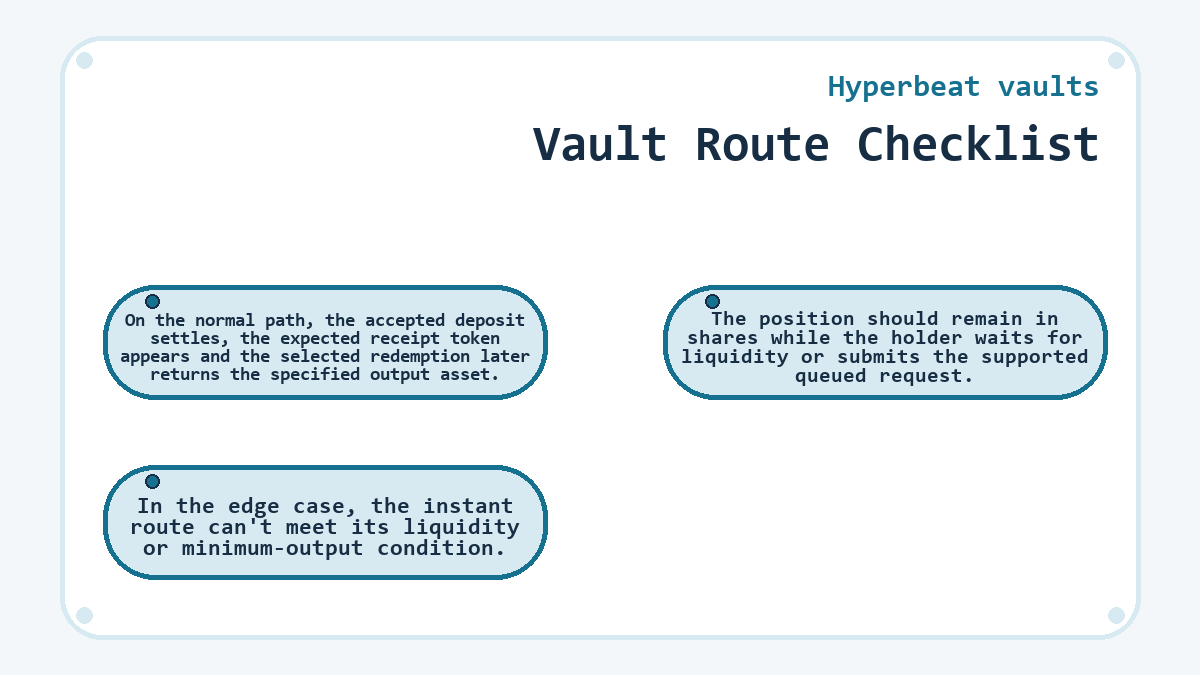
On the normal path, the accepted deposit settles, the expected receipt token appears and the selected redemption later returns the specified output asset. In the edge case, the instant route can't meet its liquidity or minimum-output condition. The position should remain in shares while the holder waits for liquidity or submits the supported queued request.
Fees, Yield and Strategy Risk
A net-return comparison combines strategy performance, the vault's fee schedule, redemption costs and the value of the asset ultimately received.
The vault cards present trailing net APY over a recent period, so the displayed rate describes past performance rather than a fixed future exchange rate. Performance fees also vary by vault. A fee applied to strategy performance is separate from an instant-redemption fee, and neither includes the network cost of submitting transactions.
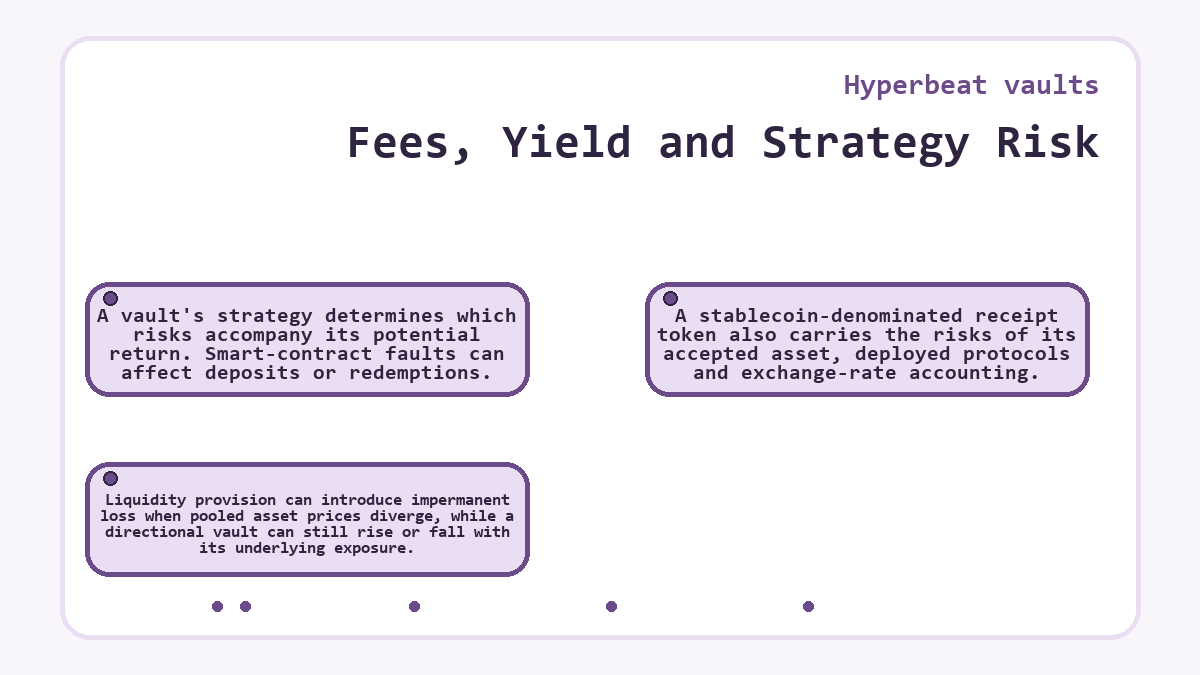
A vault's strategy determines which risks accompany its potential return. Smart-contract faults can affect deposits or redemptions. Liquidity provision can introduce impermanent loss when pooled asset prices diverge, while a directional vault can still rise or fall with its underlying exposure. A stablecoin-denominated receipt token also carries the risks of its accepted asset, deployed protocols and exchange-rate accounting.
Audit reports and proof-of-solvency views answer narrower questions. An audit reviews code and assumptions within a defined scope. Solvency data compares reported reserves with liabilities at a particular observation point. Neither mechanism promises that every strategy position can exit instantly or at a fixed value.
Completion Checks and Exit Recovery
Completion evidence depends on the route: a deposit ends with receipt tokens, an instant exit ends with the output asset and a queued exit begins with a recorded request.
A wallet signature proves authorization, while a submitted transaction only shows that execution was attempted. For a deposit, check the successful transaction and the expected receipt-token balance. For an instant redemption, check that shares were consumed and the intended output reached the receiving wallet. A quoted amount or approval transaction isn't the final state.
Queued redemptions require an intermediate status. The request should remain identifiable until processing sends the underlying asset, and a pending request shouldn't be mistaken for a failed exit. Submitting duplicates before checking that state can create another request rather than repair the first one.
If an instant redemption reverts because liquidity or the minimum output can't be satisfied, the receipt-token balance should remain available for another supported path. Confirm that balance before changing the route. After confirming that balance, decide whether the vault's waiting period, fees and output asset remain acceptable before trying another route.
Worth knowing
Does Token Approval Alone Create a Hyperbeat Vault Position?
No. Token approval gives the selected contract permission to spend up to the approved amount, but it doesn't execute a deposit. The position begins only after the deposit transaction succeeds and the expected receipt token reaches the receiving wallet. If approval succeeds while the later deposit fails, the allowance may remain active until it is changed or revoked.
Are hbUSDC and hbUSDT Interchangeable?
No. hbUSDC and hbUSDT are separate receipt tokens issued by different vault contracts against different accepted assets. Each has its own exchange rate, balance and redemption path. Sending one token to the other vault's redemption contract doesn't convert it into a valid position. Match the receipt token to its issuing contract and supported output asset.
Is the Trailing Net APY a Fixed Redemption Rate?
No. A trailing net APY summarizes performance over a past measurement period and doesn't lock the value of a future redemption. Strategy returns, the share-to-asset exchange rate, applicable fees and the chosen exit route can all affect the final output. It shouldn't be treated as a promised return or a guaranteed price for the receipt token.
Could Moving a Vault Token Affect Redemption?
Yes. A composable receipt token may be transferred or deposited into a compatible DeFi contract, but the holder then needs control of that token before redeeming it directly. Another protocol can add contract, liquidity or withdrawal conditions of its own. The Hyperbeat redemption contract can't redeem shares that remain locked elsewhere or aren't available in the approving wallet.
Do Contract Audits Guarantee a Successful Exit?
No. An audit reviews specified code, contracts and assumptions at a point in time. It doesn't eliminate smart-contract faults, strategy losses, insufficient instant liquidity or risks introduced by later configuration changes and external protocols. Audit coverage is one comparison input, while the selected vault's exit mechanism and live transaction conditions determine whether a particular redemption can proceed.
How Does Proof of Solvency Differ From an Audit?
Proof of solvency compares reported reserves with corresponding liabilities at an observation point, while an audit examines contract code or system behavior within a stated scope. Solvency evidence doesn't show that every reserve is immediately liquid for a particular withdrawal. An audit also doesn't prove that reserves always cover liabilities, so the two checks aren't substitutes.
When Can Impermanent Loss Affect a Hyperbeat Vault?
Impermanent loss is relevant when a vault strategy supplies liquidity across assets whose relative prices can change. The pool's rebalancing can leave the strategy with a different asset mix than simple holding would have produced. This risk doesn't apply identically to every vault, so it should be tied to the deployed strategy rather than inferred from the receipt token alone.
May a Holder Redeem Only Part of a Vault Position?
A vault contract can support redemption by a specified share amount, allowing the remaining shares to stay in the wallet. The selected interface and contract still control whether partial redemption is available for that route. Instant liquidity, minimum-output protection, fees and queued processing apply to the redeemed portion under the same conditions as a full exit.