 Hyperbeat
 connects saving, trading, borrowing and card spending through routes with different practical limits
Hyperbeat gives each financial task a distinct route through a self-custodial smart wallet. An idle balance can enter an Earn strategy, funds can move into trading, accepted collateral can support borrowing and an eligible balance or credit position can fund card spending. Those routes don't finish in the same state. Match the route to the intended outcome, then surface asset support, liquidity, collateral and eligibility constraints before authorizing the action.
Choose the Outcome Before the Route
The intended end state determines where funds should go. An Earn allocation should create a visible strategy position. Trading requires an available balance followed by an order or position state. Card credit requires accepted collateral, displayed borrowing capacity and a successful payment. Starting with a feature name instead of the desired result can send funds into a position that doesn't serve the immediate job.
| Intended Result | Required Starting Condition |
|---|---|
| Earn from an idle balance | A supported asset and a selected strategy that accepts it |
| Open a trading position | Funds credited to the trading account and a supported market |
| Spend through card credit | Eligible card access, accepted collateral and available borrowing capacity |
| Decision Rule | Choose the route whose recorded completion state matches the intended job |
The same account can contain spendable funds, strategy positions, trading collateral and loan obligations at once. These balances remain functionally different even when the interface displays them together. Before moving funds, identify the required starting balance and the record that will confirm completion.
Collateral Sets the Practical Boundary
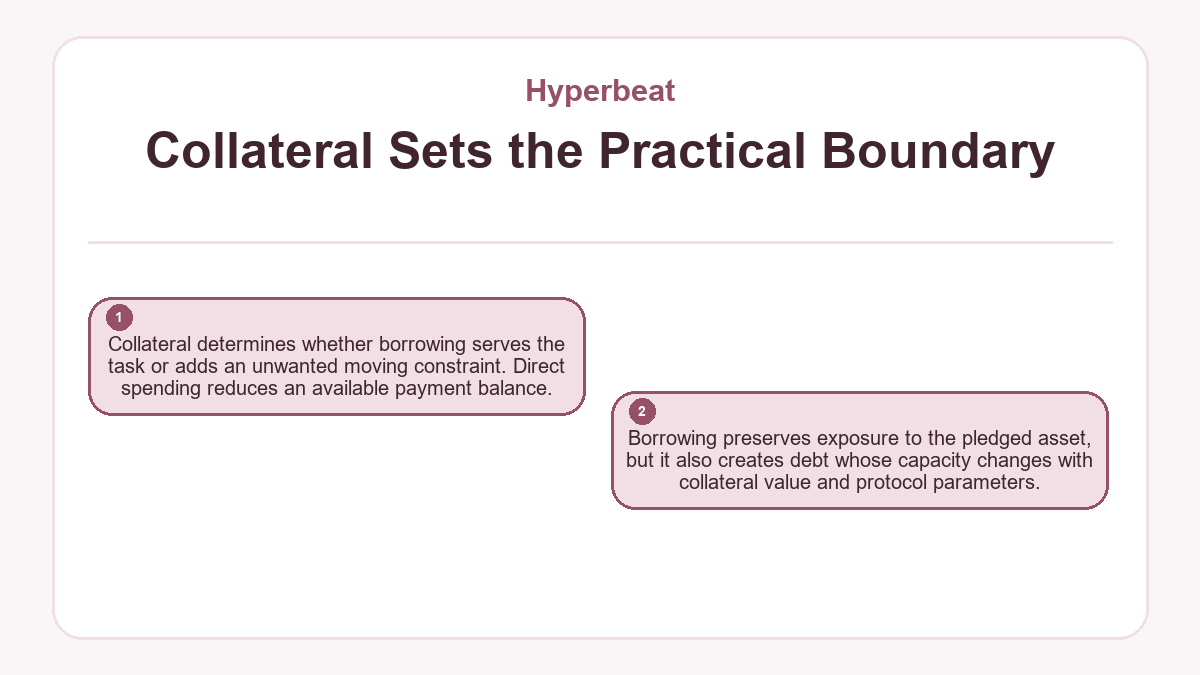
Collateral determines whether borrowing serves the task or adds an unwanted moving constraint. Direct spending reduces an available payment balance. Borrowing preserves exposure to the pledged asset, but it also creates debt whose capacity changes with collateral value and protocol parameters.
Direct Balance Spending
Cash Mode draws from an available beatUSD balance rather than opening a collateralized loan. This route fits a purchase that should have a defined funding source and no liquidation threshold. Its observable outcome is a card transaction paired with a lower payment balance. Card eligibility and merchant authorization still apply separately from the onchain balance.
Collateral-Backed Card Credit
Credit Mode supports spending against accepted collateral without first selling that collateral. Hyperbeat routes this card borrowing through dedicated Morpho Blue markets on HyperEVM. The available amount follows the underlying loan-to-value rules and the capacity shown in the Pay interface. A decline in collateral value can move the position toward liquidation, so the relevant state includes both the card payment and the resulting debt.
Borrowing for Trading
Borrow to Trade directs borrowed funds into the trading account instead of toward a purchase. The loan and the trade remain separate obligations: interest and collateral risk belong to the borrowing side, while price movement, leverage and order execution belong to the trading side. Missing eligible collateral, limited borrowing capacity or an inability to monitor both positions makes trading with an owned balance the simpler route.
Idle Balances and Earn Positions
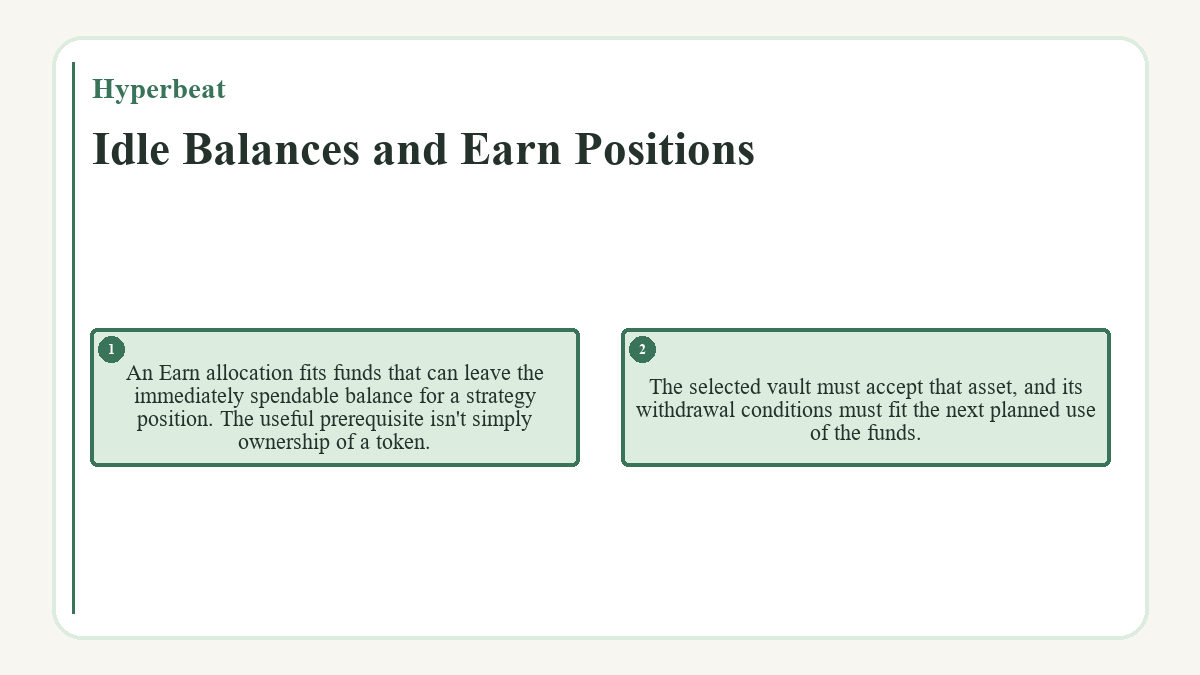
An Earn allocation fits funds that can leave the immediately spendable balance for a strategy position. The useful prerequisite isn't simply ownership of a token. The selected vault must accept that asset, and its withdrawal conditions must fit the next planned use of the funds.
Liquidity Before Yield
Liquidity matters when the balance may soon cover a card payment, transfer or trading deposit. A vault position may require withdrawal before that value can serve another job. For Morpho supply vaults, withdrawals depend on sufficient liquidity in the vault and its underlying markets. A displayed return doesn't remove that exit condition.
Position Evidence
A successful Earn action should produce a recorded deposit and a visible strategy balance or share position. Wallet authorization alone doesn't show that the allocation completed. Changing yield figures describe the position's performance at a point in time rather than a fixed return. Compare value available in the wallet with value committed to a strategy and its withdrawal path.
Trading Begins With Available Margin
A trading use case starts only after the required funds appear in the trading account. A transfer request or source-chain transaction may be part of that path, but neither proves that the destination balance is ready for an order.
Funding State
Trading funds can arrive from another Hyperbeat balance or through a supported external route. External timing depends on the source network's confirmations, while route availability and network cost should appear before confirmation. Asset, network and destination must agree. A valid address format doesn't establish that an unsupported asset will become trading collateral.
Order State and Exit
An order needs its own completion evidence after funding. A filled spot order changes the asset balance, while a filled perpetual order creates or adjusts market exposure and margin. Pending, partial and rejected orders leave different states, so an authorized order isn't the same as a completed trade. Hyperbeat Trade uses one unified balance to support both spot activity and perpetual positions.
Trading proceeds can later move toward spending, a bank route or an external wallet when the relevant destination is available. That exit is a new operation. Closing a position proves that market exposure changed, but it doesn't prove that the proceeds reached a card balance or repaid a separate loan.
When Does One Route Fit Better?
A predictable expense usually favors an available payment balance over a new collateralized obligation. The input is already denominated for spending, and completion can be checked against the card record and remaining balance. Credit becomes relevant when retaining exposure to accepted collateral matters enough to justify interest, changing borrowing capacity and liquidation risk.
An Earn position suits funds that don't need immediate reuse and whose withdrawal path matches the expected timeline. Trading suits a deliberate market-exposure goal, not merely the desire to move money somewhere productive. Borrowing to trade combines a loan with a market position, so the user must monitor changing debt capacity and market exposure.
One missing prerequisite can settle the choice early. Without an accepted vault asset, available trading balance or eligible collateral, the corresponding route can't produce its intended state. A functional alternative should start from the balance that already exists and finish in a state the user can verify.
Completion Is Specific to the Job
A signature records approval of the request, while the resulting product record shows whether the requested state transition occurred. Reading both prevents a pending or partial action from being mistaken for a finished one.
Onchain Product State
Onchain actions leave different records that should match the request:
- An Earn allocation shows a strategy position rather than only a wallet debit.
- A trade shows an order fill, balance change or open position after funds reach the trading account.
- A borrowing action shows an outstanding loan and updated collateral health.
- A withdrawal shows value returning to the selected destination balance.
Payment and Account State
Payment evidence belongs to the card or account path as well as the chain. Merchant authorization, settlement and any resulting balance or debt update describe different stages. A temporary card decline doesn't by itself prove that collateral disappeared, just as a collateral deposit doesn't prove that a purchase settled.

For example, a card payment funded by credit should leave a payment record and a corresponding borrowing state. Either record alone describes only part of that event. The same separation applies when trading proceeds move to another account: the closed trade and the credited destination are two distinct facts.
Helpful answers about Hyperbeat
-
Does an Earn Deposit Remain Available for an Immediate Card Payment?
- No. An Earn deposit becomes a strategy position rather than a freely spendable card balance. To use that value for a payment, the relevant amount generally must be withdrawn or moved into an eligible payment balance first. Withdrawal timing depends on the product and available liquidity, so funds reserved for an imminent expense may fit better outside the strategy.
-
Is a Bank Transfer Required to Fund a Small Hyperbeat Test?
- No. A supported crypto transfer can fund the account, while available fiat rails provide another entry path. The test starts only after the chosen balance appears in the product that will use it. Card access, bank rails and supported assets can have separate eligibility or availability conditions, so one working funding route doesn't prove that every spending route is active.
-
How Do Market Minimums Affect a Small Trading Test?
- A market can reject an order that falls below its minimum size even when the trading balance is funded. Check the order form's current requirements before submitting the trade, then distinguish a rejected order from a failed deposit. In the first case, the funds reached the account but the requested order didn't meet the market's execution conditions.
-
Could a Card Payment Be Declined Even With Accepted Collateral?
- Yes. Accepted collateral is only one condition for card credit. The account also needs enough borrowing capacity under the applicable loan-to-value rules, an eligible card and a transaction that passes merchant and card-network authorization. Inspect the payment status and borrowing state separately before changing the collateral position, because a decline doesn't identify which condition failed.
-
Does Closing a Trade Automatically Clear a Loan Used to Fund It?
- No. Closing the trade changes the market position, while the borrowing balance remains a separate obligation until it is repaid through the applicable lending path. Trading proceeds may provide funds for repayment, but their existence doesn't perform that action. Check both the closed-position record and the outstanding loan balance before treating the combined use case as finished.
-
Which Balance Reaches the Card After Sweeping a non-USDC Spot Asset?
- The spot asset is converted to USDC before the value is swept toward the card balance. That conversion adds a distinct state change between holding the asset and having spendable funds. Check the resulting USDC amount and the destination credit rather than assuming the original token moved directly into the card account.
-
When Can an Earn Withdrawal Take Longer Than Expected?
- An Earn withdrawal can take longer when the selected vault or its underlying markets lack enough immediately available liquidity. The position may still be recorded correctly even though the requested value hasn't returned to the wallet balance. Treat the withdrawal as complete only when the destination balance updates, and keep near-term spending funds outside a strategy whose exit conditions don't match the planned timing.